
A 14th-Century Bible from St. Albans: Inside a Medieval English Manuscript
More than six centuries ago, somewhere in medieval England, a scribe carefully put ink to parchment.
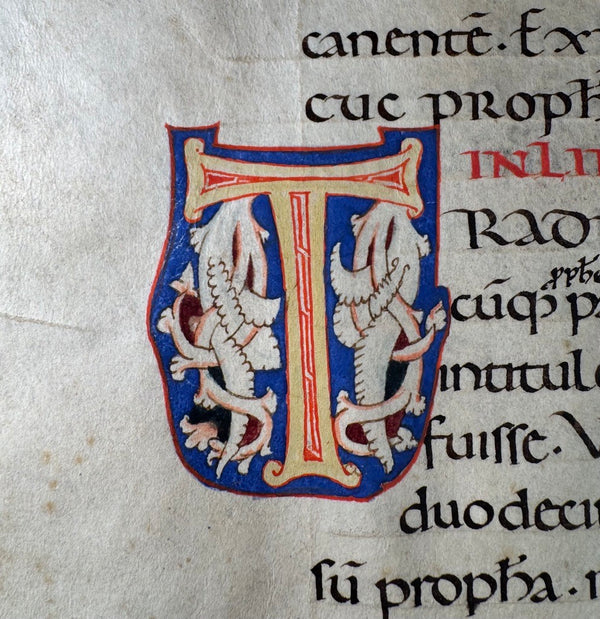
Line after line of the Latin Vulgate was copied in precise Gothic script. Elaborate decoration extended into the margins. Gold leaf was applied by hand, catching the light much as it still does today.
The result was part of a magnificent large-format Bible associated with one of medieval England's great religious institutions: St. Albans Abbey.
I recently had the opportunity to examine and handle a genuine 14th-century leaf associated with this tradition. Beyond its beauty, the manuscript provides a fascinating window into a changing period in the history of the Bible—when medieval book production was becoming increasingly sophisticated and the ways Bibles were produced, studied, and used were undergoing significant changes.
But to understand the manuscript, we first need to understand the place whose name it carries.
Who Was St. Alban?
Long before St. Albans became one of medieval England's great monastic centers, there was Alban himself.
According to ancient Christian tradition, Alban lived in Roman Britain near the city of Verulamium, close to modern St. Albans.
The traditional account tells of a Christian priest fleeing persecution who sought refuge in Alban's home. Alban was not initially a Christian, but while sheltering the priest, he was deeply affected by his faith.
When Roman authorities arrived searching for the fugitive, Alban reportedly exchanged clothing with the priest and presented himself to the soldiers instead.
He was arrested.
When ordered to renounce his newfound Christian faith, Alban refused.
He was eventually executed and came to be remembered as Britain's first Christian martyr.
The story was recorded centuries later by the Venerable Bede and became one of the best-known accounts of early Christianity in Britain.
Whatever questions remain concerning the precise details and dating of Alban's martyrdom, his memory became deeply embedded in English Christianity.
A religious community eventually developed near the traditional location of his death.
That community would become St. Albans Abbey.
One of Medieval England's Great Monastic Centers
By the Middle Ages, St. Albans had become an important Benedictine monastery.
Medieval monasteries were far more than places where monks gathered for worship.
They were centers of learning, writing, historical preservation, manuscript culture, and intellectual activity.
Before the invention of the printing press in Europe, every book had to be produced by hand.
The Bible was no exception.
Producing a substantial biblical manuscript required enormous resources: parchment had to be prepared, scribes had to copy hundreds of thousands of words, artists and decorators could embellish the pages, and expensive materials such as gold might be incorporated into important manuscripts.
A major monastery such as St. Albans existed within this manuscript culture.
And the leaf I examined provides a beautiful surviving example of the kind of Bible production associated with medieval England.
A Bible More Than 600 Years Old
The manuscript leaf dates broadly to the 14th century, probably somewhere around the middle of the 1300s.
It contains text from the Latin Vulgate—the form of the Bible that dominated Western Christianity throughout much of the Middle Ages.
This was not a tiny Bible designed to fit into someone's pocket.
It came from a substantially larger folio-format Bible.
That distinction matters.
During the 13th century, Paris became particularly famous for producing remarkably compact Bibles. Extremely thin parchment and tiny, precise handwriting allowed scribes to compress the entire biblical text into books small enough to be carried by students, friars, and scholars.
This manuscript represents a different visual experience.
Its larger page provided space not only for the biblical text but also for elaborate decoration.
It was meant to impress.
Gothic Script and Medieval Craftsmanship
One of the most immediately recognizable features of the manuscript is its script.
The biblical text is written in a form of Gothic textualis, the dense, angular handwriting that many people now instinctively associate with medieval manuscripts.
To modern eyes, Gothic script can initially appear difficult to read.
Letters are tightly arranged. Vertical strokes dominate the page. Abbreviations allowed scribes to conserve space. Yet the writing was not careless or crude.
Quite the opposite.
Producing a manuscript like this required extraordinary discipline.
Every line had to remain consistent. Columns needed to be carefully arranged. Rubrication, initials, decoration, and biblical text all had to work together within the planned page.
More than six centuries later, we can still examine the individual decisions made by the people who created it.
Illuminated With Gold
The decoration is perhaps the most visually striking feature of the leaf.
Elaborate vinery extends from the text, and decoration appears on both the recto and verso—the front and back—of the parchment.
Most impressive is the use of gold leaf.
Even after hundreds of years, the gold can still catch and reflect light.
Today we are accustomed to books being produced by machines in enormous quantities. A modern Bible can be printed, bound, shipped, and replaced relatively inexpensively.
A manuscript like this belonged to an entirely different world.
Its parchment, script, pigments, decoration, and gold were all the result of human labor.
A medieval Bible was not merely printed information.
It was an object painstakingly created by hand.
The Bible Before the Printing Press
This is one of the reasons I find medieval manuscripts so fascinating.
Today, the Bible is extraordinarily accessible.
We can own multiple printed copies. We can search the entire biblical text from a phone in seconds.
For most of Christian history, none of that was possible.
Scripture had to be physically copied.
One manuscript produced another. Scribes reproduced the text generation after generation, and monasteries, churches, universities, professional workshops, and individual patrons all played roles in that process.
By the 13th and 14th centuries, that world was changing significantly.
Universities were expanding.
Demand for books was increasing.
Professional scribal workshops were becoming increasingly important.
Methods of book production were becoming more standardized.
And the Bible stood at the center of much of this activity.
Paris and the Medieval Bible Revolution
The 13th century brought one of the most important developments in the history of the medieval Bible.
Paris emerged as a major intellectual and book-production center.
The growth of the University of Paris helped create demand for biblical manuscripts that were smaller, more standardized, and easier for individual scholars to use.
The result was the famous Paris pocket Bible.
These Bibles could be astonishingly small. Scribes used extremely thin parchment and minute handwriting to fit the enormous biblical text into a portable codex.
That represented a dramatic departure from the massive Bibles of earlier centuries.
But the older large-format tradition did not simply disappear.
England continued producing substantial biblical manuscripts within its own ecclesiastical and intellectual environment.
The manuscript associated with St. Albans gives us a glimpse into that world.
A Changing World of Book Production
That makes this manuscript interesting for reasons beyond its artistic beauty.
It comes from a transitional period.
Medieval book production was moving beyond a world dominated exclusively by monastic copying. Universities, professional scribes, commercial workshops, wealthy patrons, and religious institutions all contributed to an increasingly complex book economy.
Yet large and prestigious manuscripts remained important.
The result was not an overnight transition from “monastic manuscripts” to “commercial books.”
The two worlds overlapped.
A manuscript like this allows us to see that overlap.
Its large format, Gothic script, decorative program, and gold illumination preserve the prestige associated with monumental medieval Bible production while belonging to an age in which the production and use of books were rapidly evolving.
England's Own Manuscript Tradition
Medieval Bibles can sometimes appear remarkably similar at first glance.
A manuscript produced in France, England, or Italy might share Gothic handwriting, Latin Vulgate text, two-column layouts, decorated initials, and other familiar characteristics.
Yet regional differences existed.
Manuscript scholars examine details such as script, decoration, parchment preparation, layout, pigments, textual features, and artistic style to understand when and where a manuscript may have been produced.
That is part of what makes studying these objects so interesting.
A single leaf may appear to be simply a beautiful piece of medieval calligraphy.
But it can contain clues about the people who produced it, the artistic traditions surrounding them, the institutions that commissioned books, and the broader intellectual world in which the manuscript was used.
What Does This Leaf Contain?
The leaf contains a portion of the Book of Ezekiel.
That means the words preserved on this parchment were copied by hand more than six hundred years ago.
The manuscript has survived extraordinary changes since then.
Kingdoms rose and fell.
The printing press transformed the production of books.
The Reformation reshaped Western Christianity.
The Bible was translated and printed in languages throughout the world.
Eventually, Scripture became available digitally on devices carried in our pockets.
And yet this parchment survived.
The ink remains.
The decoration remains.
The gold still reflects the light.
Why Medieval Bible Leaves Matter
It can be tempting to look at a medieval manuscript simply as an antique.
But these objects are much more than that.
They are physical witnesses to the history of the biblical text.
Every surviving manuscript represents a moment when someone intentionally reproduced Scripture for another generation.
That does not mean medieval scribes were perfect, nor does it mean every manuscript is textually identical. Hand copying naturally produced variants, corrections, abbreviations, and other features that manuscript scholars continue to study.
But manuscripts like this allow us to physically trace the Bible through history.
They help answer questions that are easy to overlook when we pick up a modern printed Bible:
Who copied Scripture?
Where did they copy it?
What materials did they use?
Who paid for these books?
How were they read and studied?
How did Bible production change as universities and professional bookmaking developed?
And how did the physical form of the Bible evolve long before Gutenberg transformed Europe with movable-type printing?
A single medieval leaf can open the door to all of those questions.
Holding a Piece of Biblical History
That is ultimately what draws me to manuscripts like this one.
It is beautiful, certainly.
The Gothic script, elaborate decoration, and surviving gold make it an extraordinary object in its own right.
But its greatest value is the history it preserves.
This piece of parchment connects us with medieval England, with the manuscript culture surrounding institutions such as St. Albans, and with generations of Christians who encountered Scripture in a form radically different from the Bibles we use today.
More than six hundred years ago, someone sat down and copied these words from Ezekiel.
Today, we can still hold that work in our hands.
And through manuscripts like this, we can follow the remarkable physical history of the Bible as it was copied, transmitted, preserved, and passed from one generation to the next.
Watch the Full Video
Want to see the manuscript up close?
In the full video, I examine this remarkable medieval Bible leaf, explore its Gothic script, gold illumination, and historical context, and tell the story of St. Alban and the medieval abbey that bears his name.
Watch on YouTube: Exploring a Medieval Bible Associated with St. Albans
About The Divine Library
The Divine Library explores the history of the Bible through ancient artifacts, biblical manuscripts, archaeology, and Christian history. Follow along as we examine the physical evidence, manuscripts, artifacts, and historical places that connect the modern Bible with the ancient and medieval worlds.