

The Divine Library
13th-Century Medieval Latin Bible Manuscript – 2 Chronicles 11–12 – Paris, France, c. 1250–1275
13th-Century Medieval Latin Bible Manuscript – 2 Chronicles 11–12 – Paris, France, c. 1250–1275
Couldn't load pickup availability
An Extraordinary 750-Year-Old Handwritten Bible Manuscript from Medieval France
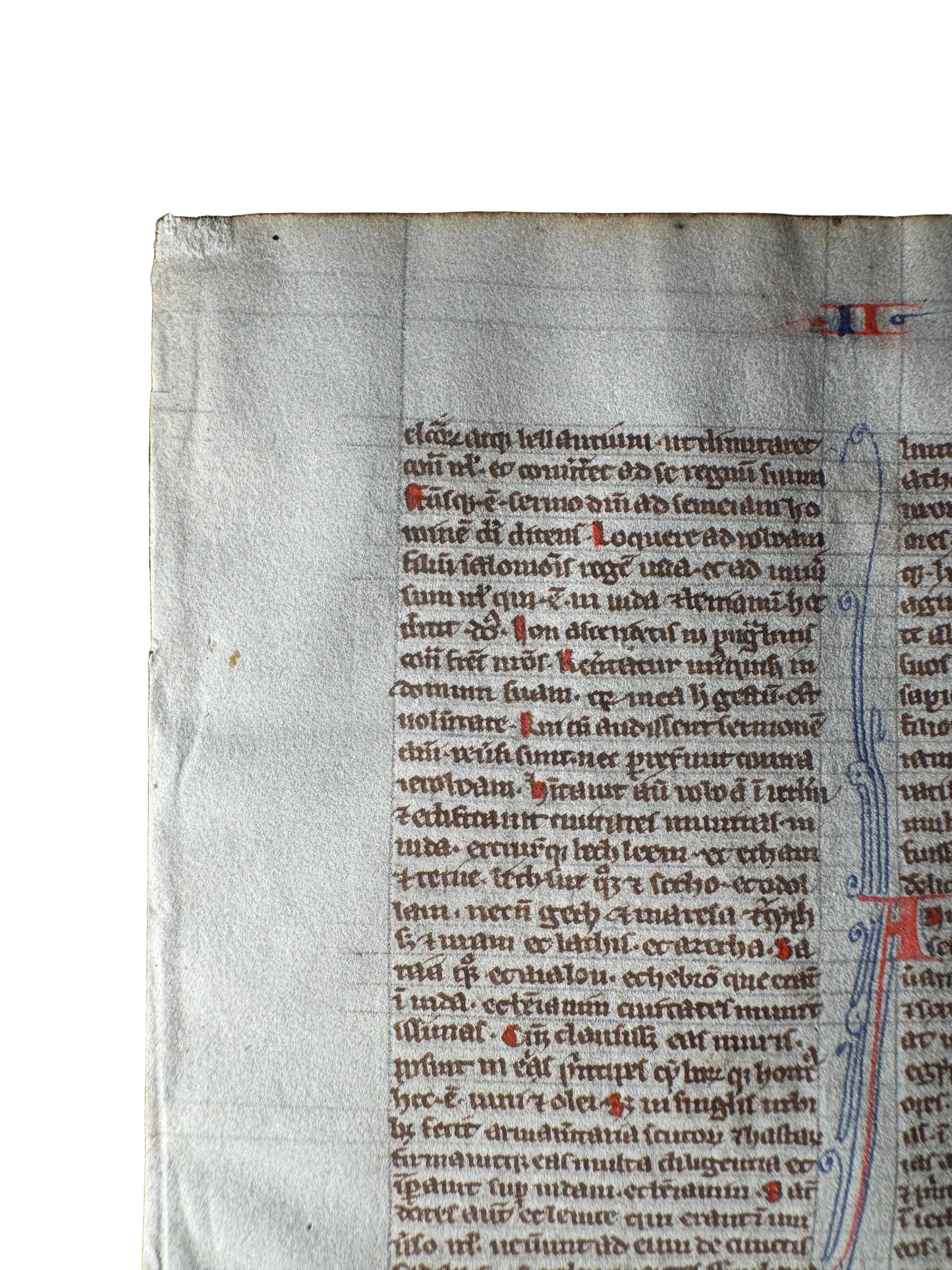
Offered here is an exceptional original medieval Bible manuscript leaf dating to approximately 1250–1275 AD, originating from Paris, France, one of Europe’s most important centers of biblical scholarship and manuscript production during the Middle Ages.
Handwritten in Latin on genuine animal-skin parchment (vellum), this remarkable manuscript contains text from 2 Chronicles, chapters 11–12, recounting the reign of King Rehoboam, the division of the kingdom of Israel, and the events surrounding the strengthening and eventual invasion of Judah.
Produced more than two centuries before the widespread adoption of Gutenberg’s printing technology, this manuscript represents an extraordinary period in biblical history when every copy of Scripture was painstakingly reproduced by hand.
The leaf features exceptionally fine Gothic minuscule script arranged in two columns, accompanied by alternating red and blue initials, elegant ornamental penwork, and red rubrication. The intricate decorations, particularly the elongated blue penwork extending into the margins, demonstrate the remarkable artistry and precision of medieval manuscript production.
Biblical Content: 2 Chronicles 11–12
The manuscript preserves a portion of the Old Testament book of 2 Chronicles, specifically chapters 11 and 12.
These chapters describe the reign of Rehoboam, the son of King Solomon, following the division of the united kingdom of Israel.
The narrative recounts Rehoboam’s efforts to strengthen the southern kingdom of Judah, including the construction and fortification of defensive cities throughout his territory. It also describes the migration of priests and Levites who remained committed to worship in Jerusalem following the religious changes introduced in the northern kingdom.
Chapter 12 continues the account with the invasion of Judah by Shishak, king of Egypt, and the subsequent humbling of Rehoboam and the leaders of Jerusalem.
These passages provide an important biblical account of the political and religious challenges facing the kingdom of Judah following Solomon’s death.
The Medieval Paris Bible
During the 13th century, Paris became one of Europe’s foremost centers of biblical scholarship, particularly through the growing influence of the University of Paris.
The increasing demand for portable copies of Scripture among theologians, university scholars, and members of religious orders contributed to the development of the medieval Paris Bible.
Unlike the enormous manuscript Bibles of previous centuries, these smaller volumes employed exceptionally thin parchment and extraordinarily compact handwriting, allowing extensive biblical texts to be incorporated into more manageable books.
Creating such manuscripts required tremendous skill and patience. Scribes carefully prepared and ruled parchment sheets before copying the Latin biblical text letter by letter. Decorators then added colorful initials and ornamental penwork to distinguish textual divisions and enhance the manuscript’s appearance.
This surviving leaf beautifully illustrates the sophistication of that medieval tradition.
Manuscript Details
- Date: Circa 1250–1275 AD
- Origin: Paris, France
- Biblical Text: 2 Chronicles 11–12
- Language: Latin
- Material: Genuine animal-skin parchment (vellum)
- Dimensions: 145 × 100 mm (approximately 5.7 × 3.9 inches), according to the accompanying descriptive label
- Script: Microscopic Gothic minuscule
- Layout: Two columns containing approximately 47 lines of handwritten text per column
- Decoration: Alternating red and blue initials with contrasting ornamental penwork
- Rubrication: Red lettering and decorative accents
- Format: Original medieval manuscript leaf, handwritten on both sides
Condition
The manuscript remains in attractive condition for its considerable age, retaining its finely executed Gothic handwriting and decorative red and blue initials.
Age-related discoloration, minor staining, and natural parchment irregularities are present. There is also some residual adhesive from previous mounting along the upper portion of one side of the manuscript. Close examination of the photographs will show the full extent of the remaining adhesive.
Faint original ruling lines remain visible throughout the parchment, providing a fascinating glimpse into the preparation and craftsmanship of medieval manuscript production.
The manuscript is accompanied by an older descriptive presentation mount identifying its date, origin, dimensions, and biblical passage.
A Remarkable Piece of Biblical History
For more than seven centuries, this manuscript has survived as a tangible witness to the handwritten transmission of Scripture.
Created during an era when Bibles were painstakingly copied by professional scribes, it represents both the devotion to preserving the biblical text and the extraordinary craftsmanship of medieval bookmaking.
The manuscript predates Gutenberg’s famous printed Bible by approximately 200 years and provides a direct connection to the scholarly and religious culture of 13th-century Europe.
Whether displayed as a historical artifact, incorporated into a collection of medieval manuscripts, or preserved as a piece of Christian heritage, this original Bible leaf offers a remarkable opportunity to own an authentic artifact from the Middle Ages.
An original 13th-century handwritten Bible manuscript, preserving more than 750 years of biblical history.
Share