

The Divine Library
14th–15th Century Medieval Latin Manuscript – Commentary on 1 Corinthians 11 and the Eucharist
14th–15th Century Medieval Latin Manuscript – Commentary on 1 Corinthians 11 and the Eucharist
Couldn't load pickup availability
A remarkable medieval Latin theological manuscript leaf, attributed to the 14th or early 15th century, containing commentary on the Apostle Paul’s teaching concerning the Lord’s Supper. Presented in an existing cream-colored beveled window mat.
Written by hand on parchment approximately 600 years ago, this manuscript preserves a fascinating interpretation of 1 Corinthians 11:28–30, exploring the importance of spiritual self-examination before receiving Communion.
The Biblical Passage: 1 Corinthians 11:28
The manuscript begins with the words:
Probet autem seipsum homo…
“Let a man examine himself…” — 1 Corinthians 11:28
This passage introduces Paul’s instructions regarding the proper reception of the Lord’s Supper.
The medieval commentator expands upon Paul’s warning, explaining why spiritual preparation and self-examination were considered essential before participating in the Eucharist.
A Fascinating Medieval Medical Analogy
One of the most interesting features of this manuscript is its comparison between physical and spiritual nourishment.
The author explains that ordinary food, although beneficial in itself, may become harmful when received by someone suffering from an unhealthy bodily condition.
The manuscript develops this analogy using medieval medical concepts, particularly the theory of bodily humors.
A passage reads:
Sic cibus corporalis eum veneno invenit adversis humoribus occupatum, aperte nocet et ledit. Ita cibus spiritualis.
Translation:
“Thus bodily food, when it encounters someone affected by adverse humors, openly harms and injures him. So too with spiritual food.”
The writer applies this comparison to the Eucharist, arguing that receiving Communion while spiritually unprepared can bring judgment upon the recipient.
The text also discusses temporal, spiritual, and eternal consequences associated with unworthy Communion, drawing upon Paul’s warning in 1 Corinthians 11:30.
This combination of biblical interpretation, sacramental theology, and medieval medical reasoning provides a fascinating glimpse into Christian intellectual history.
A Window into Medieval Biblical Scholarship
The manuscript appears to have originated in a pastoral or scholastic theological setting, possibly as part of a sermon collection, theological notebook, or instructional manuscript.
Its single-column format, extensive Latin abbreviations, and relatively informal Gothic handwriting are consistent with the types of manuscripts used by medieval scholars, clergy, and students.
The exact author and original manuscript collection remain unidentified.
Physical Description and Presentation
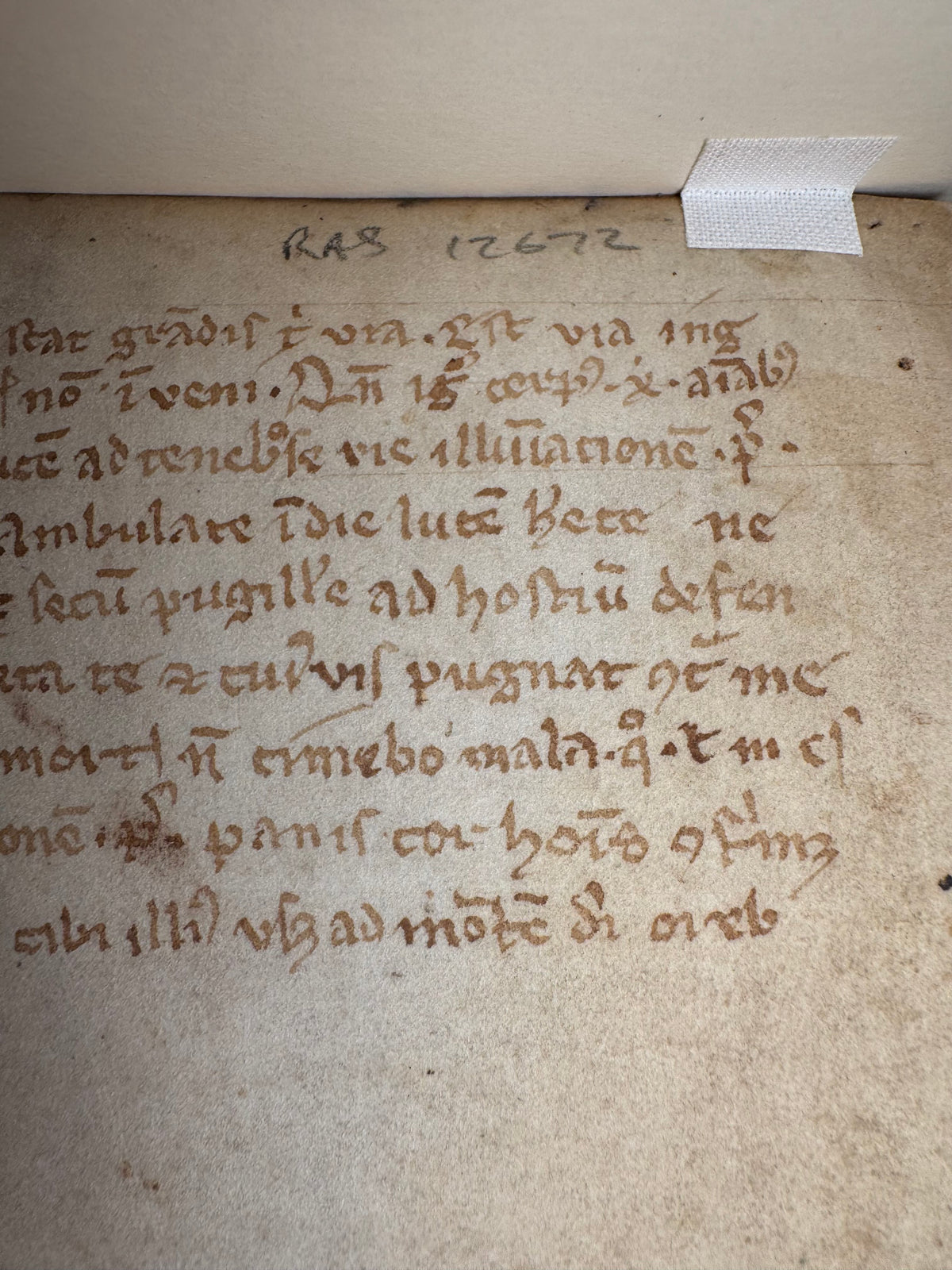
The manuscript is handwritten in Latin on parchment, with text on both sides of the leaf.
The front contains approximately two dozen lines of theological commentary, while the reverse preserves additional writing across its upper portion.
The manuscript is currently presented within a cream-colored beveled window mat, providing an attractive display suitable for a collector or historical exhibit.
The manuscript will be sold in its existing mat and has not been removed from the mounting for this listing. The reverse was photographed before the present display arrangement, as shown in the accompanying images.
The leaf exhibits natural age-related discoloration, staining, edge wear, and surface irregularities consistent with historical use.
Manuscript Specifications
- Date: Circa 14th–early 15th century (attributed)
- Language: Medieval Latin
- Material: Parchment
- Script: Gothic cursive / late Gothic book hand
- Contents: Commentary on 1 Corinthians 11:28–30
- Subject: Eucharist, Communion, biblical interpretation, medieval theology
- Format: Single handwritten leaf, recto and verso
- Manuscript dimensions: Approximately 8¼ × 5¼ inches (estimated while mounted)
- Presentation: Cream-colored beveled window mat
- Origin: Western Europe (precise location undetermined)
- Condition: Antique condition with natural discoloration, staining, and edge wear
Historical Significance
This manuscript offers a tangible connection to the history of Christian biblical interpretation during the later Middle Ages.
Its discussion of Paul’s teaching on the Lord’s Supper demonstrates how medieval scholars combined Scripture, theological reasoning, and contemporary medical concepts to explain spiritual truths.
For collectors of medieval manuscripts, Christian history, biblical studies, and historical theology, this leaf represents a particularly interesting surviving example of pre-Reformation biblical commentary.
A fascinating piece of medieval Christian intellectual history, preserving the interpretation of Scripture in handwritten form centuries before the widespread adoption of printing.
Research note: The identification of the biblical passage and theological subject is supported by preliminary transcription and analysis. The manuscript’s exact date, geographical origin, and authorship remain undetermined. Dimensions are approximate, and the leaf has not been removed from its existing mat for inspection.
Share