

The Divine Library
Early Incunable Canon Law Fragment on Handmade Paper Likely Continental Europe, c. 1470–1475
Early Incunable Canon Law Fragment on Handmade Paper Likely Continental Europe, c. 1470–1475
Couldn't load pickup availability
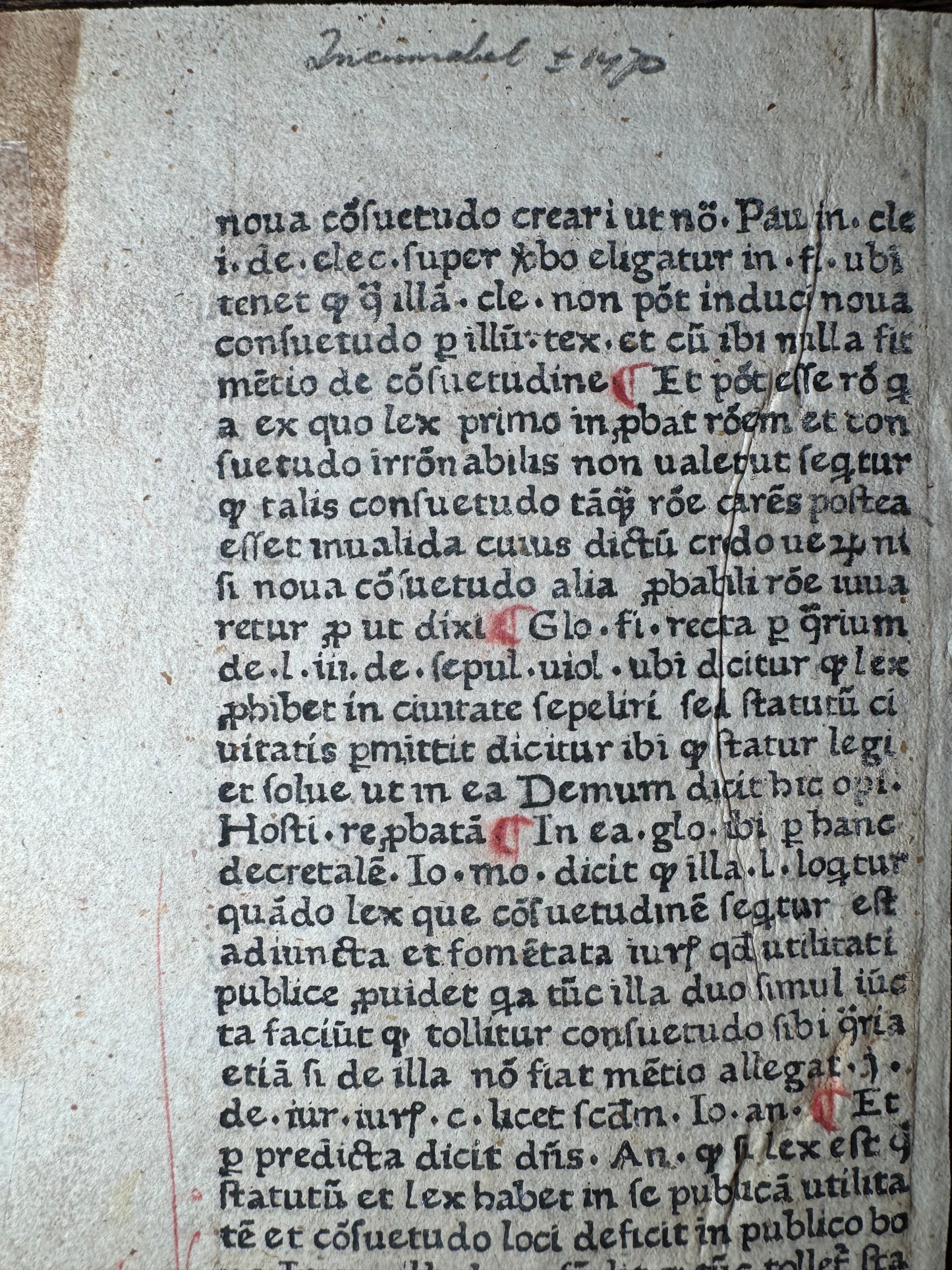
An authentic incunable-era printed fragment dating to the earliest generation of European typography. Printed on handmade laid paper in Gothic type and enhanced with contemporary hand-applied rubrication, this fragment represents a remarkable survival from the infancy of the printed book and the period immediately following Gutenberg’s revolutionary invention of movable type.
Based upon research conducted by the present owner, comparison with other fifteenth-century printed works, and information accompanying the fragment from the auction house from which it was acquired, this piece is believed to originate from a canon law text or legal commentary printed in Continental Europe around 1470–1475. The style of typography appears consistent with some of the earliest generations of movable-type printing, although the precise edition and printer remain subjects for further scholarly study.
The fragment contains dense scholarly Latin text with hand-added red paragraph marks supplied after printing. This combination of printing and manuscript finishing is characteristic of the earliest decades of typography, when printed books still closely imitated the appearance of medieval manuscripts. Such rubrication was commonly added by hand after the sheets left the printing press, making each surviving example a unique witness to the transition from manuscript culture to the age of print.
Details
- Date: c. 1470–1475 (attributed)
- Origin: Continental Europe
- Material: Printed ink on handmade laid paper
- Subject: Canon law / legal commentary (attributed)
- Typography: Early Gothic type
- Decoration: Contemporary hand rubrication
- Dimensions: Approximately 4.3 × 5.2 inches (11 × 13.2 cm)
Condition
The fragment survives in good condition considering its age, with expected trimming from its original parent volume, minor age toning, and signs of historic use. The text remains dark, sharp, and highly legible. Two small adhesive remnants from a previous mounting remain attached to the leaf, a common occurrence with fragments that have been preserved or displayed in earlier collections. These remnants are visible in the photographs and have been left undisturbed as part of the item’s history.
An exceptional artifact from the earliest age of printing and a tangible connection to the period when books were first being produced through movable type. More than 550 years old, this fragment offers collectors, historians, and bibliophiles the opportunity to own an authentic piece of printing history from the dawn of the printed book.
Share