

The Divine Library
Original 16th-Century Renaissance Woodcut — Io Restored to Human Form
Original 16th-Century Renaissance Woodcut — Io Restored to Human Form
Couldn't load pickup availability
Virgil Solis (1514–1562) | Ovid’s Metamorphoses | Germany, 16th Century
An original Renaissance woodcut illustrating the dramatic conclusion of the story of Io from Book I of Ovid’s Metamorphoses.
According to Ovid, Jupiter transformed Io into a heifer in an attempt to conceal her from Juno. What followed was a remarkable journey involving the hundred-eyed Argus, Mercury, Juno, and Io’s wandering across the ancient world.
Eventually Io reaches Egypt, where Jupiter persuades Juno to bring her suffering to an end.
Io is finally transformed back into a woman.
The present woodcut belongs to this concluding portion of Io’s story and comes from the celebrated Renaissance illustration tradition associated with German artist Virgil Solis (1514–1562).
Solis’s famous series of woodcuts illustrating Ovid’s Metamorphoses first appeared at Frankfurt in 1563. The blocks were subsequently reused in later 16th-century editions, making it difficult to assign surviving individual fragments to a specific printing without further bibliographical evidence.
The Original Latin Survives
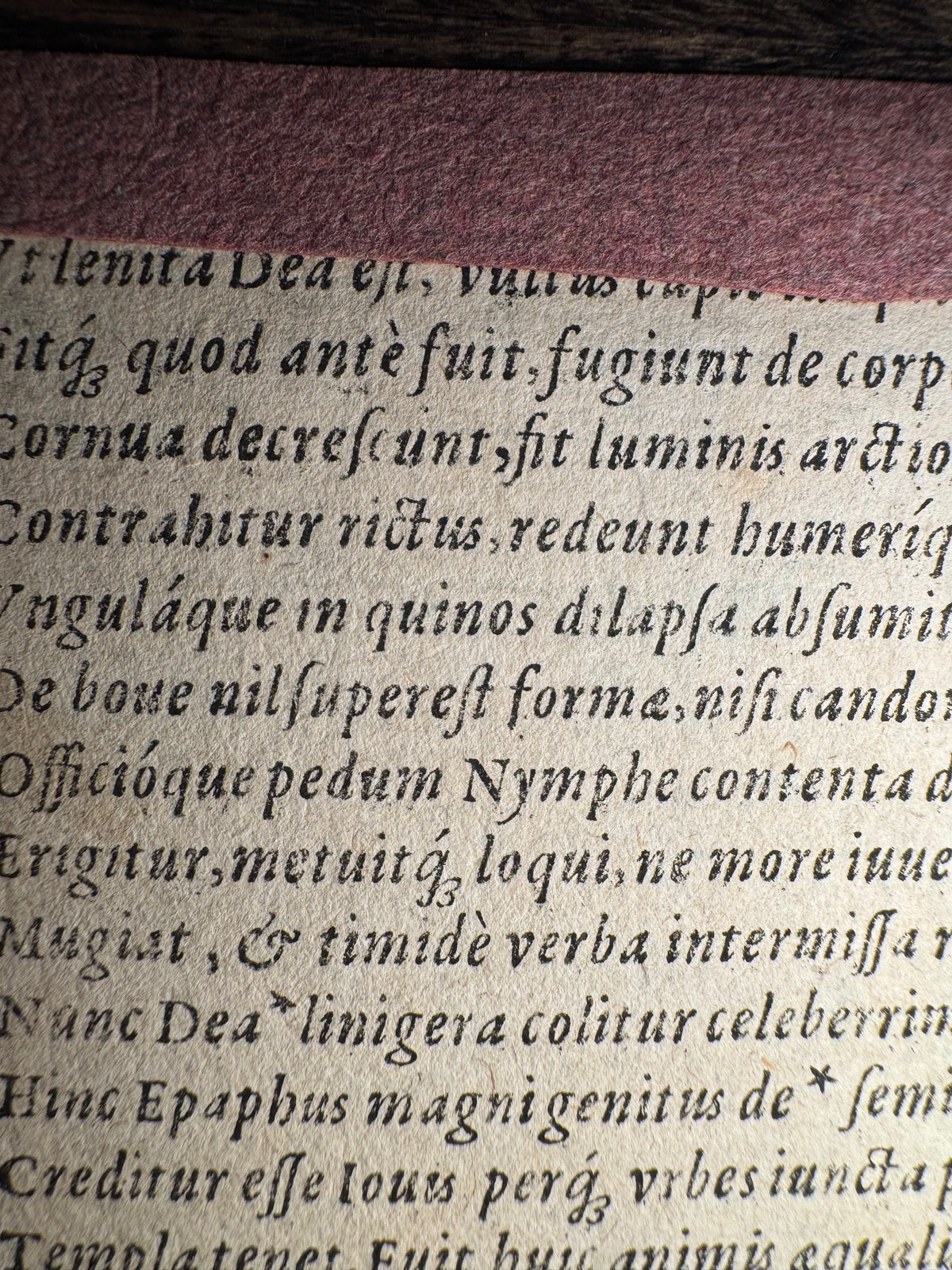
Remarkably, substantial portions of the original Latin text remain on the reverse of this fragment.
The text can be identified as Ovid, Metamorphoses, Book I, approximately lines 738–750.
It describes the moment Io’s transformation is reversed:
“Fitque quod ante fuit: fugiunt de corpore setae,
Cornua decrescunt, fit luminis arctior orbis…”
Her animal hair disappears.
Her horns diminish.
Her bovine features recede.
Her shoulders and hands return, and her hooves separate into human fingers.
Ovid summarizes the transformation with the remarkable line:
“De bove nil superest, formae nisi candor, in illa.”
Nothing of the cow remains except her whiteness.
Io cautiously attempts to speak again, fearful that she might still hear the lowing of the heifer.
The passage then declares that she is worshiped as a goddess by the linen-clad people and introduces Epaphus, the son of Io and Jupiter.
The survival of these lines provides direct textual evidence identifying the fragment with the conclusion of Io’s story in Ovid.
Details
Artist/Design: Virgil Solis (1514–1562)
Subject: Io Restored to Human Form
Work: Ovid, Metamorphoses
Book: Book I
Text: Approximately lines 738–750
Design first published: Frankfurt, 1563
Date: 16th century
Origin: Germany
Medium: Original woodcut on laid paper
Reverse: Original Latin letterpress
Approx. image size: 6.3 × 8.2 cm
Condition
The woodcut itself remains exceptionally attractive, with a strong impression and excellent surviving detail for a print approximately 450 years old.
The reverse retains substantial original Latin letterpress together with remnants from an old mounting. A reddish strip of mounting paper remains adhered across the upper portion of the reverse.
The old mounting material has intentionally been left undisturbed to avoid risking damage to the original Renaissance paper.
Please examine all photographs carefully for the condition of this original 16th-century fragment.
Share