

The Divine Library
Original 16th-Century Renaissance Woodcut — Narcissus at the Fountain
Original 16th-Century Renaissance Woodcut — Narcissus at the Fountain
Couldn't load pickup availability
Ovid’s Metamorphoses | Germany, 16th Century | Associated with Virgil Solis
An original 16th-century Renaissance woodcut depicting one of the most famous scenes from classical mythology: Narcissus discovering his own reflection.
The story appears in Book III of Ovid’s Metamorphoses.
Narcissus was the son of the river god Cephisus and the nymph Liriope and was renowned for his extraordinary beauty. Many fell in love with him, but Narcissus rejected their affection—including that of the nymph Echo.
His pride ultimately brought about his destruction.
While exhausted from hunting, Narcissus came upon a clear and undisturbed spring. As he bent over the water to drink, he saw a beautiful face staring back at him.
It was his own.
Unable to recognize the image as merely a reflection, Narcissus became hopelessly captivated by it.
The present woodcut captures this celebrated moment, showing the young hunter kneeling beside the water and gazing toward the pool while the wooded landscape and hunting imagery surrounding him establish the setting of Ovid’s story.
Original 16th-Century Latin on the Reverse
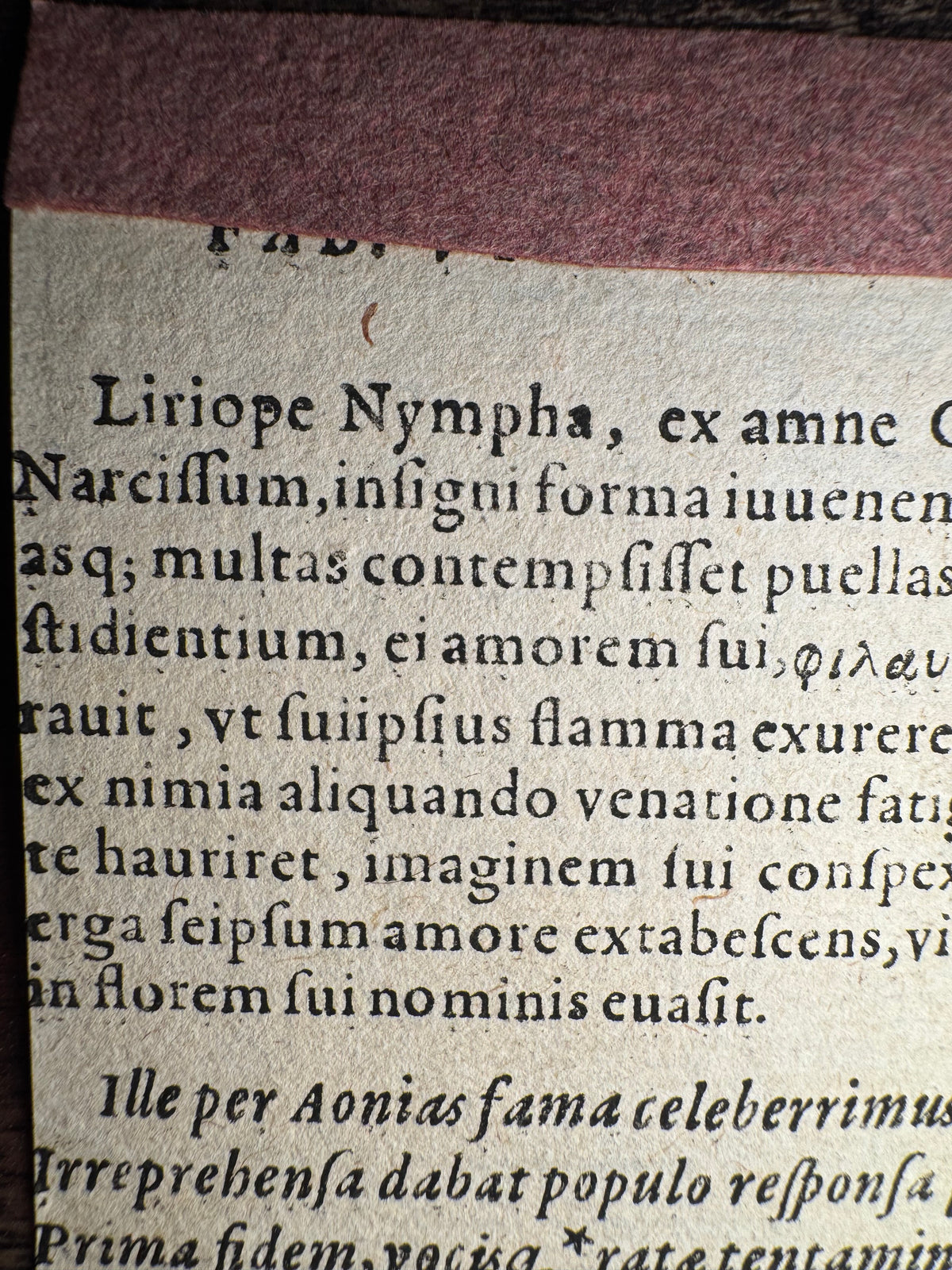
Remarkably, substantial original Latin letterpress survives on the reverse—and directly identifies the subject.
The text begins:
“Liriope Nympha, ex amne Cephiso procreabat Narcissum, insigni forma iuvenem…”
It identifies Liriope, the river Cephisus, and their son Narcissus, describing him as a youth of exceptional beauty.
The passage then summarizes the tragedy.
Narcissus rejects Echo and numerous other young women. Nemesis punishes his contempt. Exhausted after hunting, Narcissus approaches a spring to drink, sees his own image in the water, and becomes consumed by love for himself.
Unable to possess the object of his desire, he eventually wastes away and dies.
The surviving text then transitions into the story of Echo, whose unrequited love for Narcissus forms one of the most memorable episodes of Ovid’s Metamorphoses.
The combination of the Renaissance woodcut on the front and the surviving Latin account on the reverse makes this a particularly evocative fragment of an early printed edition of Ovid.
Details
Artist/Design: Associated with Virgil Solis (1514–1562)
Subject: Narcissus at the Fountain / Narcissus and His Reflection
Source: Ovid, Metamorphoses, Book III
Date: 16th century
Origin: Germany
Medium: Original woodcut on laid paper
Reverse: Original Latin letterpress describing Narcissus and Echo
Approx. image size: 6.3 × 8.2 cm
Condition
The woodcut survives with a strong and attractive impression and excellent detail for its age.
The reverse retains substantial original Latin letterpress together with remnants of an old mounting. A reddish strip of mounting paper remains adhered across the upper portion of the reverse.
The historical mounting material has intentionally been left undisturbed to avoid risking damage to the approximately 450-year-old paper.
Please examine all photographs carefully, particularly those of the reverse, as they form an important part of the condition description.
Share