

The Divine Library
Original 16th-Century Virgil Solis Woodcut — Atalanta & Hippomenes Transformed into Lions
Original 16th-Century Virgil Solis Woodcut — Atalanta & Hippomenes Transformed into Lions
Couldn't load pickup availability
Virgil Solis (1514–1562) | Ovid’s Metamorphoses | Germany, 16th Century
An original 16th-century Renaissance woodcut illustrating the extraordinary conclusion of the myth of Atalanta and Hippomenes from Book X of Ovid’s Metamorphoses.
Atalanta was renowned throughout the ancient world for her extraordinary speed. Determined to avoid marriage, she declared that she would marry only the man capable of defeating her in a footrace.
Hippomenes accepted the challenge—but knew that he could not defeat Atalanta through speed alone.
He appealed to Venus.
The goddess gave him three golden apples and instructed him to throw them during the race. Each time Atalanta stopped to retrieve one, Hippomenes gained precious ground.
The plan succeeded.
Hippomenes defeated Atalanta and won her hand.
But he failed to properly thank the goddess who had given him victory.
Transformed Into Lions
Angered by Hippomenes’ ingratitude, Venus caused the couple to violate the sanctity of a shrine associated with Cybele, the Mother of the Gods.
Their punishment was extraordinary.
Atalanta and Hippomenes were transformed into lions.
The present woodcut captures this dramatic conclusion to their story. The transformed lovers appear as two lions before a classical sanctuary, while the goddess sits enthroned within the temple.
The image belongs to the celebrated Renaissance Ovid illustration tradition of Virgil Solis (1514–1562), whose woodcuts for the Metamorphoses first appeared at Frankfurt in 1563 and were reused in subsequent 16th-century editions.
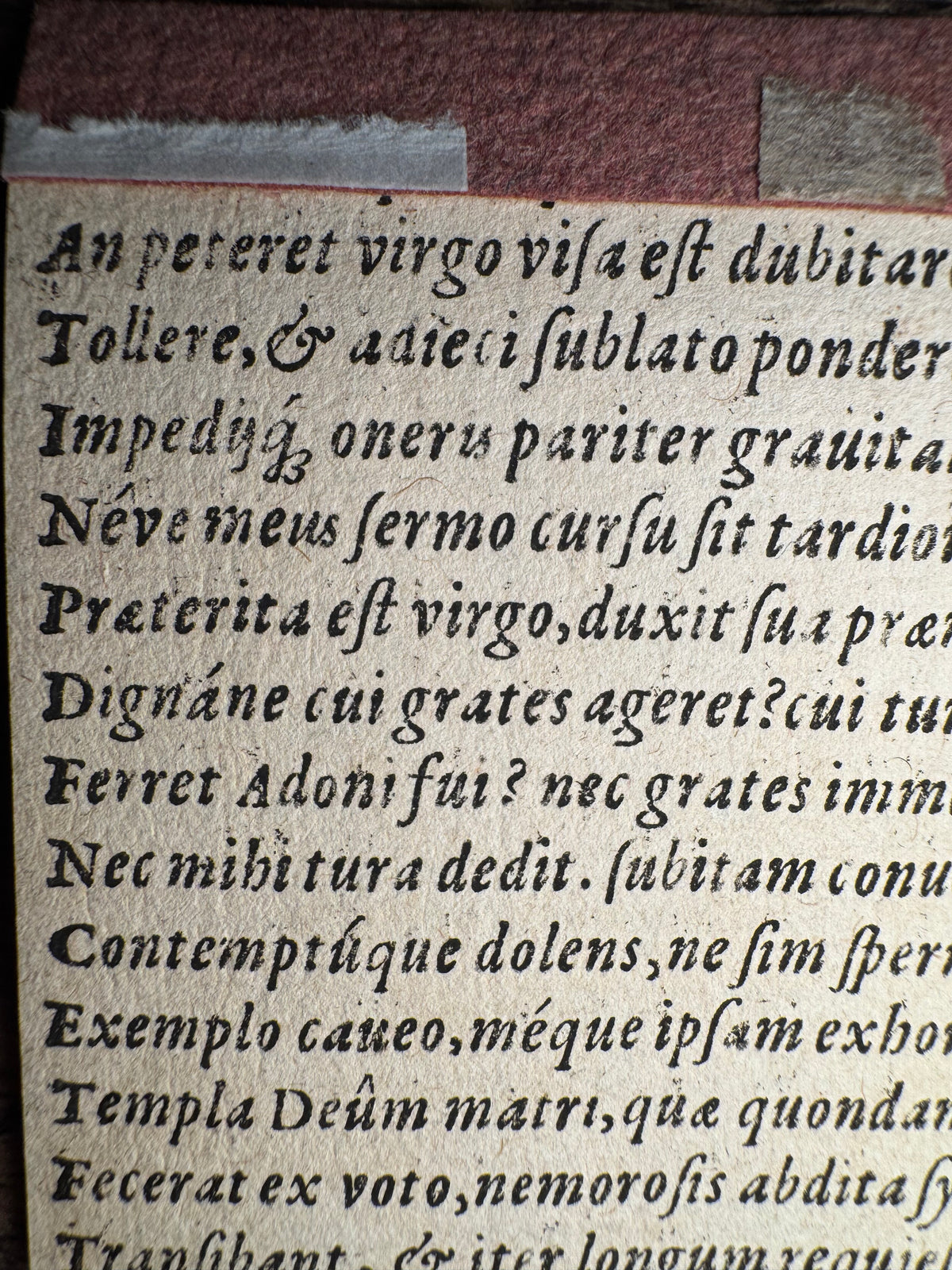
The Original Latin Survives
Substantial original Latin letterpress survives on the reverse and provides remarkable direct evidence for identifying the scene.
The visible text corresponds to Ovid, Metamorphoses, Book X, approximately lines 676–688.
It begins during the final moments of the race between Atalanta and Hippomenes. Atalanta hesitates before retrieving the golden apple thrown by Hippomenes, but Venus compels her to take it.
Slowed by the apple, Atalanta is overtaken.
“Praeterita est virgo: duxit sua praemia victor.”
The maiden was passed; the victor carried away his prize.
Venus then recounts Hippomenes’ failure to thank her for providing the means of his victory. Enraged at the insult, she determines to punish the couple.
The final surviving lines describe Atalanta and Hippomenes approaching a temple of the Mother of the Gods—the setting for the act that ultimately results in their transformation into lions.
The physical fragment therefore preserves both Renaissance imagery and the original Latin narrative immediately preceding the transformation it illustrates.
Details
Artist/Design: Virgil Solis (1514–1562)
Subject: Atalanta and Hippomenes Transformed into Lions
Work: Ovid, Metamorphoses
Book: Book X
Visible Latin: Approximately lines 676–688
Design first published: Frankfurt, 1563
Date: 16th century
Origin: Germany
Medium: Original woodcut on laid paper
Reverse: Original Latin letterpress
Approx. image size: 6.3 × 8.2 cm
Condition
The woodcut survives with a strong, attractive impression and excellent detail for its age.
The fragment has been trimmed from its original book leaf.
The reverse retains substantial original Latin letterpress together with remnants from an old mounting. A reddish strip of mounting paper remains adhered across the upper portion, along with smaller traces of historical mounting material.
The old mounting material has intentionally been left undisturbed to avoid risking damage to the approximately 450-year-old paper.
Please examine all photographs carefully, particularly those of the reverse, as they form an important part of the condition description.
Share