

The Divine Library
Original 16th-Century Virgil Solis Woodcut — Ceres, Triptolemus & King Lyncus
Original 16th-Century Virgil Solis Woodcut — Ceres, Triptolemus & King Lyncus
Couldn't load pickup availability
Virgil Solis (1514–1562) | Ovid’s Metamorphoses | Germany, 16th Century
An original 16th-century Renaissance woodcut illustrating the extraordinary story of Ceres, Triptolemus, and King Lyncus from Book V of Ovid’s Metamorphoses.
Dominating the upper portion of the composition is one of the most fantastic images in the Solis Ovid cycle:
Ceres riding through the clouds in a chariot drawn by winged serpents or dragons.
Below her unfolds a story of jealousy, attempted murder, divine intervention, and transformation.
The Mission of Triptolemus
Ceres—the Roman goddess of agriculture—entrusted the young Triptolemus with an extraordinary mission.
He was to travel throughout the world spreading the knowledge of grain and agriculture.
For his journey, Ceres provided him with her supernatural chariot, drawn through the heavens by winged serpents or dragons.
Eventually Triptolemus arrived in Scythia and entered the palace of King Lyncus.
The king welcomed the traveler and asked where he had come from and what had brought him to his kingdom.
Triptolemus explained his divine mission.
But Lyncus became jealous.
Desiring to claim the achievement for himself, the king attempted to murder Triptolemus while the young man slept.
A King Transformed Into a Lynx
Ceres intervened before Lyncus could complete the murder.
The king who had attempted to steal the goddess’s gift was transformed into a lynx.
Virgil Solis captures the supernatural character of the story dramatically. The attempted attack unfolds below while Ceres appears majestically overhead, traveling among the clouds in her serpent-drawn chariot.
The result is an extraordinary surviving example of Renaissance visual storytelling based upon classical mythology.
Original Ovid Text on the Reverse
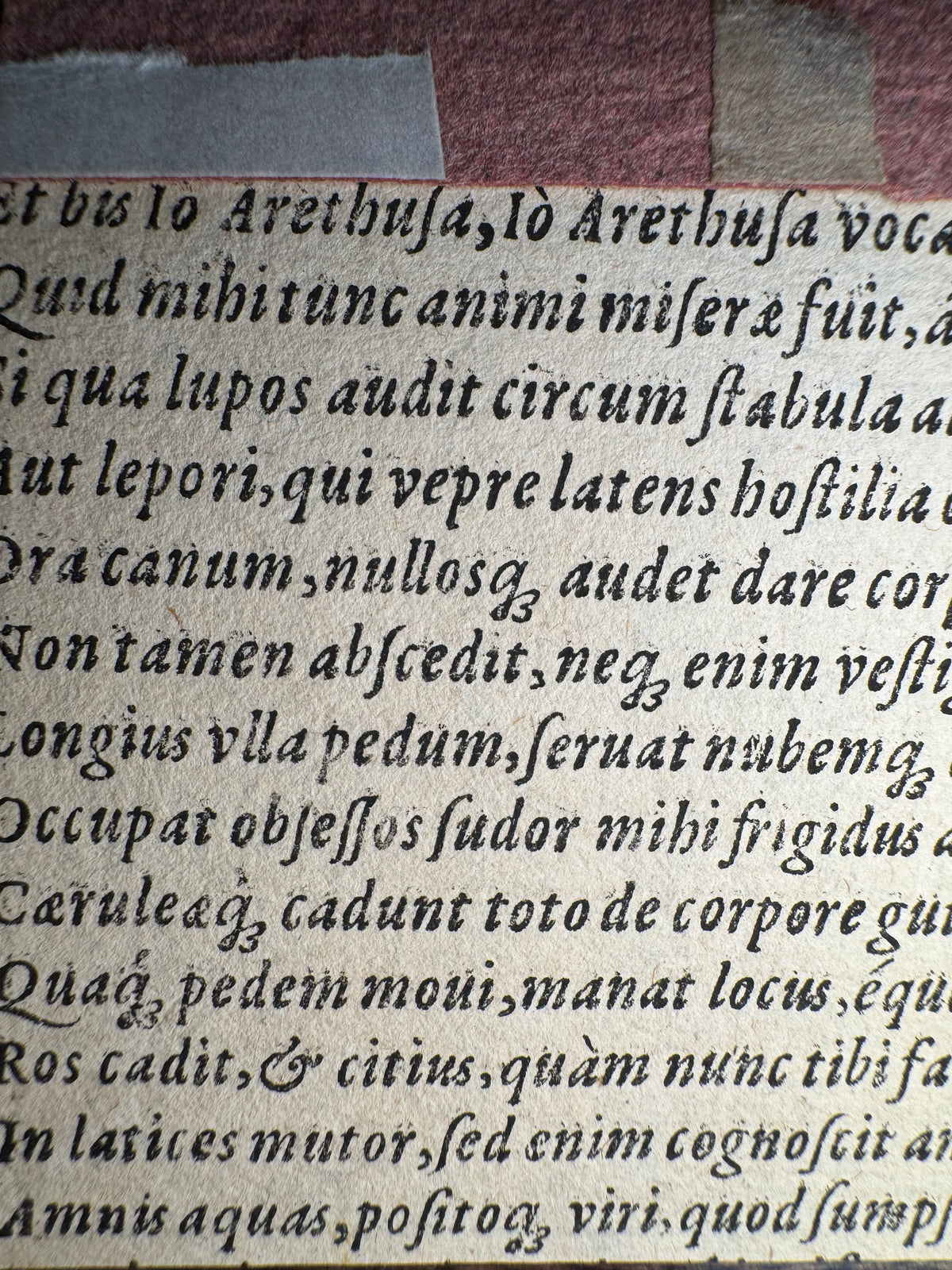
Substantial original Latin letterpress survives on the reverse.
Remarkably, the text preserves the conclusion of the Arethusa and Alpheus story immediately preceding this section of Book V.
The passage begins with Alpheus repeatedly calling:
“Arethusa! Arethusa!”
Arethusa remains concealed and terrified.
Then her transformation begins.
Cold sweat covers her body. Drops of water fall from her limbs. Water flows wherever she moves her foot, while moisture falls from her hair.
Finally:
“In latices mutor…”
“I am changed into water.”
The fragment therefore preserves two extraordinary transformations from Ovid: the reverse records Arethusa transforming into water, while the accompanying illustration belongs to the subsequent narrative culminating in King Lyncus being transformed into a lynx.
Details
Artist/Design: Virgil Solis (1514–1562)
Subject: Ceres, Triptolemus & King Lyncus
Work: Ovid, Metamorphoses
Book: Book V
Reverse text: Conclusion of Arethusa and Alpheus
Design first published: Frankfurt, 1563
Date: 16th century
Origin: Germany
Medium: Original woodcut on laid paper
Reverse: Original Latin letterpress
Approx. image size: 6.3 × 8.2 cm
Condition
The woodcut survives with a strong, attractive impression and extensive fine detail.
The fragment has been trimmed from its original book leaf.
The reverse retains substantial original Latin letterpress together with remnants from an old mounting. A reddish strip of mounting paper remains adhered across the upper portion, along with smaller traces of previous mounting material.
The historical mounting material has intentionally been left undisturbed to avoid risking damage to the approximately 450-year-old paper.
Please examine all photographs carefully, particularly the reverse, as they form an important part of the condition description.
Share