

The Divine Library
Original 16th-Century Virgil Solis Woodcut — The Creation of Mankind
Original 16th-Century Virgil Solis Woodcut — The Creation of Mankind
Couldn't load pickup availability
Prometheus & the Creation of Man | Ovid’s Metamorphoses | Germany, 16th Century
An original 16th-century Renaissance woodcut illustrating one of the foundational episodes of classical mythology: the creation of mankind at the beginning of Ovid’s Metamorphoses.
Before Ovid begins his famous collection of transformations, he describes the creation and ordering of the world itself.
The stars fill the heavens.
Fish inhabit the waters.
Wild animals populate the earth.
Birds fill the air.
But creation remains incomplete.
Something is missing.
A creature possessing greater intelligence—one capable of ruling over the other animals—has yet to appear.
Then Ovid announces:
“Natus homo est.”
“Man was created.”
Prometheus Creates Mankind
Ovid presents more than one possible explanation for humanity’s creation.
Perhaps mankind was formed from divine seed by the creator of the universe.
Or perhaps the newly created earth still contained something of the heavenly substance from which it had recently been separated.
Ovid then introduces the mythological tradition associated with Prometheus, the son of Iapetus.
Prometheus mixes earth with water and fashions humanity in the likeness of the gods.
There is one particularly beautiful distinction between mankind and the animals.
While the other creatures naturally look downward toward the earth, mankind is created upright.
Human beings are given faces capable of looking toward heaven and are commanded to raise their gaze toward the stars.
The present Renaissance woodcut illustrates humanity within this newly created world, providing a remarkable visual interpretation of the opening passages of Ovid’s Metamorphoses.
Original 16th-Century Ovid Text
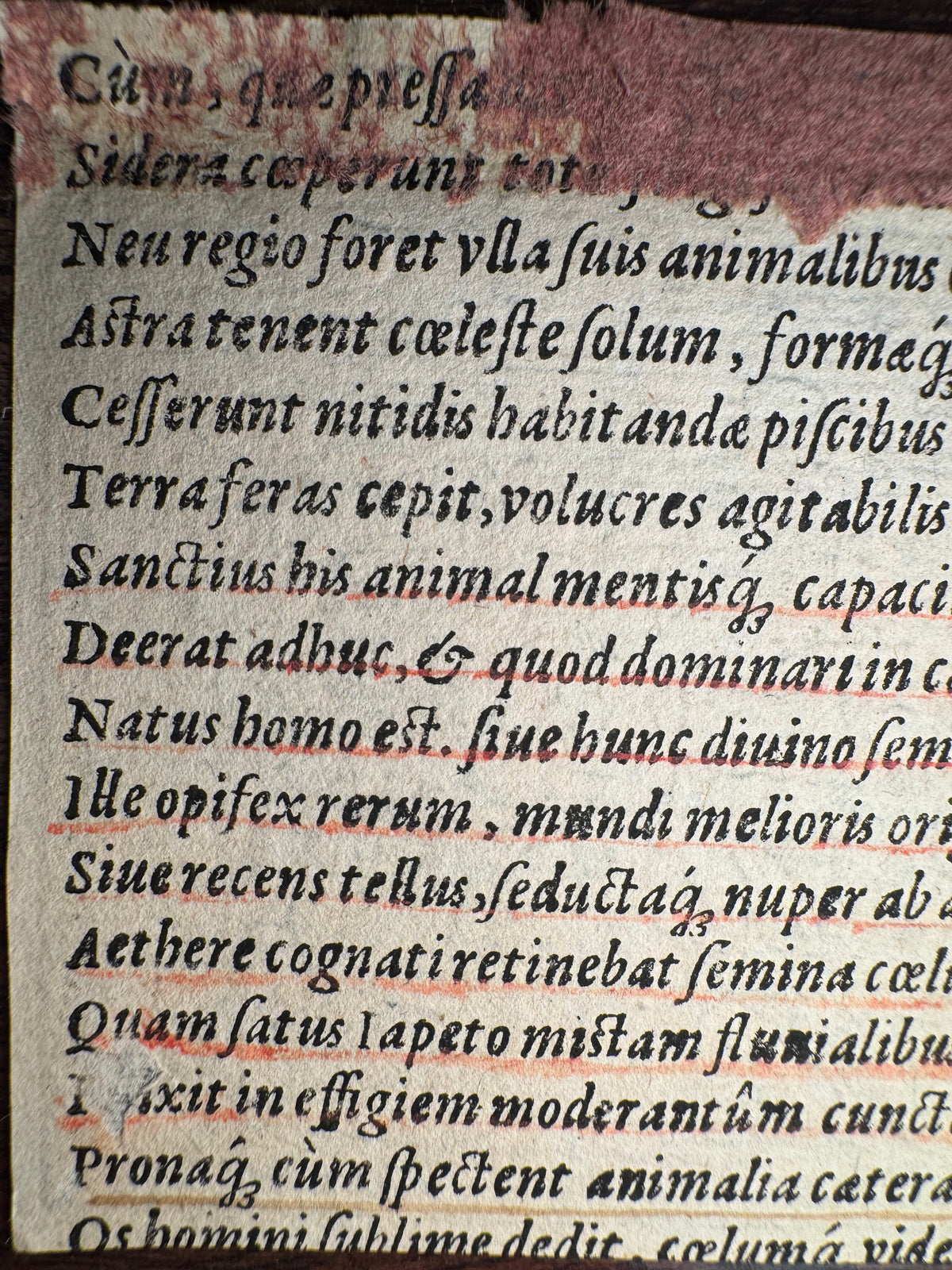
Substantial original Latin letterpress survives on the reverse and corresponds approximately to Ovid, Metamorphoses, Book I, lines 72–86.
The surviving passage contains some of the most important lines in Ovid’s creation account:
“Sanctius his animal mentisque capacius altae
Deerat adhuc…”
A more sacred creature, capable of higher thought, was still lacking.
Then:
“Natus homo est…”
“Man was created.”
The passage continues with Prometheus—the offspring of Iapetus—mixing earth with water and fashioning humanity in the image of the gods.
The physical fragment therefore preserves both a Renaissance illustration of early humanity and the original Latin text of Ovid’s ancient account of the creation of man.
Details
Artist/Design: Virgil Solis (1514–1562)
Subject: Creation of Mankind / Prometheus
Work: Ovid, Metamorphoses
Book: Book I
Visible Latin: Approximately lines 72–86
Design first published: Frankfurt, 1563
Date: 16th century
Origin: Germany
Medium: Original woodcut on laid paper
Reverse: Original Latin letterpress
Approx. image size: 6.3 × 8.2 cm
Condition
The woodcut survives with a strong and attractive impression and extensive fine detail.
The fragment has been trimmed from its original book leaf.
Substantial original Latin letterpress survives on the reverse. Several passages have been historically underlined or marked in red ink, providing evidence of an early reader’s interaction with the text.
The reverse also retains remnants of an old mounting, including a reddish strip of mounting paper across the upper portion and smaller pieces of previous mounting material.
The historical mounting material has intentionally been left undisturbed to avoid risking damage to the approximately 450-year-old paper.
Please examine all photographs carefully, particularly the reverse, as they form an important part of the condition description.
Share